Where The Fuck Are Mona Lisa’s Eyebrows: In Conversation with Keith About the Dumbest Song on the Popstar: Never Stop Never Stopping Soundtrack
If you’ve met either me or my husband Keith, you likely know that we’re obsessed with The Lonely Island mockumentary Popstar: Never Stop Never Stopping (2016). The film spoofs the kind of concert documentaries that were ubiquitous in the early part of the decade—movies like Justin Bieber’s Never Say Never (2011), Katy Perry: Part of Me (2012), and One Direction: This Is Us (2013) that mixed arena concert tour footage with behind the scenes material to ostensibly give viewers a peek into the artists’ real lives. Keith and I unquestionably formed part of the Popstar vanguard; we saw the film in the theater together, and we immediately knew it would be a cult classic. Popstar bombed theatrically, but it has indeed gained quite the following in the four years since it was released. Last year, for example, the Alamo Drafthouse chain of theaters scheduled Sing-Along showings of the movie, complete with props. (I’m jealous I didn’t get to attend one of these screenings, I have to say.)
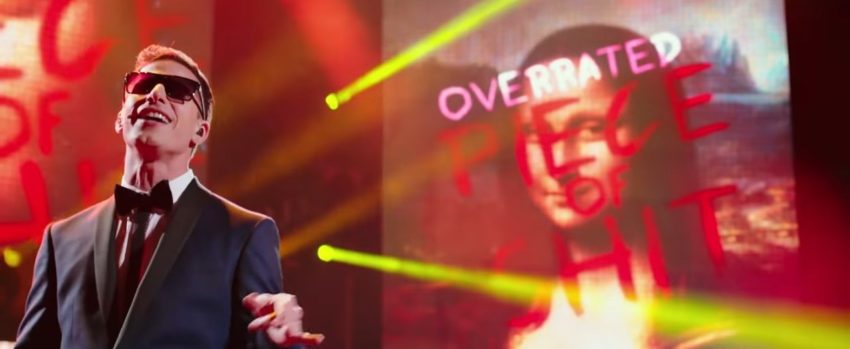
As with any good musical comedy, some of the best laughs in the film come from the songs, and Popstar’s soundtrack is full of bangers. For this month’s blog, I thought it would be fun to do a deep dive with Keith into one of our favorite songs on the soundtrack: the “powerfully stupid” “Mona Lisa.” Below is a transcript of our conversation, edited for length and clarity. (If you really want the raw audio file, complete with cat interruptions and New York sirens, to prove just how much we should NOT start a podcast, I will send it to you.)
Leah: The first thing that I wanted to ask you to do is to explain to me how much you love Popstar. Like on a scale of one to ten. How much do you love it?
Keith: Well, clearly, it’s ten. It may be one of my most watched movies.
L: We have watched it a lot. How often do you think we watch the movie together? I think it’s probably at least once a year, but it’s probably more than that?
K: No, it’s probably more like once every six months. It’s on par with how much we watch Walk Hard, I would say.
L: Yeah. I feel like that’d be a good double feature. Walk Hard and Popstar. They’re very complimentary films.
K: Usually watching one gets us to watch the other, too.
L: That’s true. Also, whenever we meet someone who hasn’t ever seen Popstar, then we have to make them watch it.
K: Well, yeah, because no one saw it when it came out; they didn’t advertise at all.
L: We are Popstar evangelists. I think many of the times we’ve seen it have been because we’ve watched it with someone who hasn’t seen it before.
K: If I had a religion, it would be Popstar.
L: So you know this movie inside and out, that’s pretty fair to say.
K: Well, I can probably quote more than I’m proud of.
L: So, if we needed a Popstar expert for court, we could call on you?
K: If Andy Samberg is busy, then I can fill in.
L: (laughs) You can be back up?
K: Uh huh.
L: So, I wanted to talk with you specifically about the song “Mona Lisa” for a few reasons. First, I think it’s probably the song off the soundtrack that we spontaneously sing to each other the most. Would you say that’s accurate?
K: Probably.
L: I mean, “Mona Lisa, you’re an overrated piece of shit” is, like, such an earworm? I think it’s just that part.
K: Yeah, I would agree, that definitely is the one that gets stuck in my head the most.
L: I also wanted to talk to you about this song because you were the one that discovered the full length version of the song on the soundtrack, right?
K: Yeah.
L: I think you showed it to me. You listened to the soundtrack before I did, and then you were like, “There’s a whole full length version of this song.”
K: Yeah. The clip of the song in the actual movie is very short. It’s, like, maybe ten or fifteen seconds.
L: Do you want to tell me a little bit about when you heard the full length version for the first time?
K: It was just when I was going to work. This was probably a couple months after the movie came out on VOD. I had one of the Popstar songs stuck in my head, and I was thinking of something to listen to. None of my podcasts were doing it for me, so I was just surfing around Google Play [Music]. And that song was still in my head, so I just decided to see if it was on Google Play. And they had the whole Popstar soundtrack; so I, of course, naturally, listened to all of it. “Mona Lisa” was one that really stuck out to me because the lyrics are very creative, and most of the song is not in the movie. There are a couple other throwaway songs on the soundtrack that aren’t exciting at all, but “Mona Lisa” seemed like a major song to leave out.
L: So would it be fair to say that “Mona Lisa” was kind of the discovery of the soundtrack?
K: Yeah. Although, I think that that was the song that I had stuck in my head. Either that or “Humble.”
L: Oh, yeah, you know all the words to that one. It’s pretty impressive.
K: Most of the words, yes. Except I can’t rap.
L: I mean… You do an Andy Samberg-level job.
K: (laughs) Yeah, yeah, that’s true.
L: You can do the rap parts, and I can do the Adam Levine parts; that’ll be our karaoke song. (laughs) So, before we listen to “Mona Lisa” again and really get into it, I’d like you to tell me what you like about the song, either in the context of the film or just as a standalone piece of music.
K: I mean, one of the reasons I like the movie in general is that the songs are so whimsical. In the film, Conner4Real has kind of lost inspiration for good songs and came up with a bunch of random throwaway songs for his new album. That whole album tanks because it’s terrible. I think that the awfulness of the Mona Lisa is just such a random topic to be singing about that it perfectly embodies how he just has no material. He’s trying to go solo without his partners and it’s bad. [pause] But it’s also true. The Mona Lisa kinda sucks.
L: (laughs)
K: We’ve been to the Louvre. There was a huge crowd around this tiny painting, and it’s not particularly impressive to look at. The history behind it is another thing, but if you just went into the museum expecting something grand and, like, awe-striking, it’s not that.
L: No, it’s very unassuming.
K: So, I don’t know, the song both fits the context of the movie and is also true. [pause] And is also an earworm. So, it just fits the bill for a perfect comedy song.
L: Yes. For me, it’s one of the songs on the soundtrack where the more I’ve listened to it, the more I’m convinced that it’s secretly brilliant. Like, it’s STUPID, but it’s stupid in a very smart way. And it gets better every time I listen to it. My favorite song the first time we saw the movie was “Finest Girl ([subtitle redacted])”.* But part of the humor of that song is the shock, right? Like, as you’re watching the movie, you’re going, “What? That’s not what I thought you were gonna say!” And so it’s hilarious because it’s the last thing you expect him to sing. When you know the song, and you know what’s gonna happen, it’s still funny; but it’s never going to be as funny as that first time when you just had no idea where it was going.
*I redacted the subtitle for spoiler reasons. Only click the link if you want the surprise spoiled! You’ve been warned. (If you’ve seen the movie and are looking for bonus content, the link leads to the full music video version of the song, not the performance scene from the film.)
K: Yeah, absolutely. The payoff is in the first time you see it.
L: Right, and I feel like “Mona Lisa” is kind of the opposite of that. At first, you hear the clip in the movie and you’re like, “Heh, heh, that’s dumb, that’s funny, yeah, the Mona Lisa sucks.” But then you listen to the full version, and you listen to it more, and you’re like, “This is sublimely stupid. It’s perfect.” (laughs) So, that’s why I thought it would be fun to dig into this song in particular, both because it’s kind of a hidden gem on the soundtrack, and also because it has increasing rewards rather than diminishing ones as you listen to it multiple times. [pause] So, are you ready to listen to the song? Let’s do it.
L: So, after listening to the song again does anything new strike you?
K: I didn’t really realize that the part that gets stuck in my head the most is actually the part that’s in the movie. But it’s also the part of the song I find the funniest, because it’s got the Garbage Pail Kid line, it’s got the DaVinci sucked a historian’s dick part, that girl who looks like uncooked bread.* I don’t know, there’s not too much new to realize about the song because I’ve heard it so many times.
*The clip in the film actually only has the Garbage Pail Kid line. It’s very short.
L: That’s true. (laughs) What I was struck by listening to it is how you can see the song as one of those unhinged Yelp reviews.
K: (laughs)
L: Like someone who’s just pissed off that this thing they’ve been looking forward to didn’t live up to their expectations, so they go on Yelp or TripAdvisor to rant about it. One kind of person would have this disappointing experience and go on Yelp and write about it—
K: Yeah, one star review.
L: Yeah! And then, you know, Conner4Real writes a song about it.
K: (laughs) Yeah, that’s accurate. Especially ending with “I’m an American man.”
L: Yes, yes, yes. There’s definitely an element of the stupid American.
K: Writing an ignorant review on Yelp.
L: (laughs) And I think that made it funnier for me, thinking about the song like that. And it goes back to what you said before about how Conner4Real is so desperate for material. I can just imagine him sitting around thinking about how much his trip to France sucked and the Mona Lisa was disappointing. And then he’s like, “I’ll write a song about that!”
K: Maybe he actually wrote the review and then, later, turned it into a song because he didn’t have anything better to do.
L: (laughs) I love that.
L: Also when I listened to the song this time, I remembered a song by Nat King Cole called “Mona Lisa.” And it’s from 1950, I think? It won the Oscar for Best Original Song that year because he had written it for a movie. [The movie was Captain Carey, U.S.A.] I think the movie was set at the end of World War II, and it was about these American soldiers in Italy. I don’t know what the song particularly has to do with the movie, other than it’s about this Italian woman who Nat King Cole is comparing to Mona Lisa. Because she’s beautiful and coy, and, you know—
K: You could land a helicopter on her forehead?
L: (laughs) Well, I was thinking about this song because in it, Mona Lisa is standing in for this kind of paragon of beauty and the height of art; so I was thinking about The Lonely Island’s “Mona Lisa” as a kind of riposte to Nat King Cole as well.
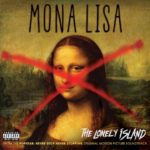
Single cover art for The Lonely Island’s “Mona Lisa”

Marcel Duchamp’s L.H.O.O.Q., 1919 version (image courtesy of Wikimedia).
L: The last thing that I want to show you is the cover art for The Lonely Island’s “Mona Lisa.” They released the song as a promotional single, which I found out when I was researching for this. So, this is the cover art. I’m an art historian, and you can’t take that out of me, so when I saw this, I immediately thought of Duchamp. He did a piece called “L.H.O.O.Q.” which, when you say it really quickly, sounds like “She has a hot ass” in French.
K: (laughs)
L: So what Duchamp did is he took a postcard—and he made multiples of these, this was kind of one of his ready mades, so there are many versions of this. He made the first one in 1919, but there are other versions that exist as well. So he took a postcard of the Mona Lisa and drew a mustache on it.
K: (laughs)
L: And put the “L.H.O.O.Q” underneath, and it was very iconoclastic. He was trying to make a commentary upon, you know, the seriousness of art and the canon. Duchamp was associated with the Dada movement for a while, and they were very kind of absurdist—
K: Flippant.
L: Yes, and also very irreverent. So when I saw the cover art for the single, I immediately thought of Duchamp putting a mustache on the Mona Lisa. And I thought, you know what, I think Duchamp would probably have approved of The Lonely Island’s “Mona Lisa.”
K: He probably would get a kick out of that.
L: (*crosses fingers*) Andy Samberg and Duchamp, like that.
K: (laughs)
L: Aright, so, I want to go through the lyrics, just stanza by stanza. We can get as nitty gritty or not as you want.
K: Sure.
INTRO
What’s up, y’all? This is Conner4Real
You know I’ve been all around the world, right?
But tonight I’m on my dumb shit
L: So, I love the intro because he says, “Tonight I’m on my dumb shit.” Like he just immediately sets up that this is gonna be a dumb ass song, so get ready.
K: (laughs) Right, and that really emphasizes that he just wrote this when he was, like, high one night or something.
VERSE 1
I’m landed in Paris at a quarter to noon
So excited to see her, I went straight to the Louvre
I heard she’s exquisite, so I bought my ticket
Pushed my way to the front of the crowd
And I couldn’t believe what I saw
L: So, I like that he sets up this narrative. He’s like, “So I’m all excited, I get to Paris, I get to the Louvre, I get there and then—”
K: Right.
L: “And I couldn’t believe what I saw.”
K: When you’re first listening to this, you could maybe think that he is going to like it? He doesn’t really give away in this first part that he’s just gonna shit all over Mona Lisa.
CHORUS 1
Mona Lisa, you’re an overrated piece of shit
With your terrible style and your dead shark eyes
And a smirk like you’re hiding a dick
What the fuck is this garbage?
Mona Lisa, the original basic bitch
Traveled thousands of miles to see your beautiful smile
Talk about a bait and switch, you ugly
L: Which I think is what makes the first line of the chorus so great. Because he’s like setting up this narrative. He’s like “Okay, I’m excited, I’m excited,” but, what do you know, “Mona Lisa, you’re an overrated piece of shit.” And then you’re like, “Okay, now we know what the song’s gonna be about.” (laughs) Then we get to “with your terrible smile and your dead shark eyes” which is good. I like that he mentions the eyes in particular because, again, everyone talks about her mysterious eyes or little smile, how her eyes follow you, and that’s part of the whole mystique of her. And he just shoots that down.
K: Her eyes are a little dead.
L: (laughs) And then, “And a smirk like you’re hiding a dick.” Which, again, that comes to the smile. So, like, it’s not a mysterious, alluring smile, it’s like—
K: She’s up to something.
L: So then he calls Mona Lisa the original basic bitch. Which… Mona Lisa is the basic bitch of art history. And then he brings up the smile again. “Traveled thousands of miles to see your beautiful smile.”
K: Yeah.
L: And then he’s like, “But you’re ugly.”
K: (laughs)
VERSE 2
I’m landed in Cairo to see the pyramids
But what did I find there? A dirty pile of bricks
There was trash all over and a very foul odor
The smell was that of a camel’s ass
But even that wasn’t as bad as
L: So then he continues this travel narrative. “By the way, here’s another thing I saw and was disappointed by.” Which again reminds me of the Yelp review, because they never stay on topic, right? When somebody’s ready to rant, when they hate something, they’re just on a roll, and then they’ll bring in other things they’re pissed about.
K: Right, like going to see the Statue of Liberty, and finding out that it’s not as big as you may have built it up to be in your head or something.
L: There’s something special about the wrath of a disappointed tourist. They’ve put all this effort into doing something on their bucket list or something that they feel they should do, and when it’s disappointing, then they don’t know how to handle it.
K: There’s actually an interesting phenomenon where Japanese tourists will get depressed after they go to Paris. I don’t remember what it was called exactly, but it does remind me of that.
L: I think that’s a very extreme version of what Conner4Real is experiencing with the Mona Lisa.
K: (laughs) Right.
L: So, getting to the end of the verse, he ultimately brings in this other example only to highlight just how bad the Mona Lisa is.
CHORUS 2
Mona Lisa, you’re worse than the pyramids
Can someone explain why the whole wide world
Is obsessed with a Garbage Pail Kid?
Looks like a Garbage Pail Kid
And DaVinci must have sucked an art historian’s dick
To get this girl who looked like uncooked bread
At the top of the all-time list of paintings
L: Now we get to your favorite part. And I found out, from the annotations on Genius Lyric, that there was actually a “Mona Loser” Garbage Pail Kid—
K: Oh, no.
L: —trading card. So that is—
K: That’s horrifying. It has the little smirk. (laughs)
L: I like the “Leonardo must have sucked an art historian’s dick” line, too. I don’t think DaVinci sucked an art historian’s dick, but this line is another way that this is a very stupid song but in a really smart way. I think the line points to the ways that the modern myth of the “genius artist” came about in the Renaissance. In the high Renaissance, Vasari wrote his Lives of the Artists, and that’s generally considered the first work of art history.* The book was made up of biographies of artists. And Vasari was Italian, so he highlighted Italian artists, obviously. DaVinci was included in this book, which is part of the reason he’s canonized as a Great Artist. There was this kind of myth making going on that was independent of the work in a lot of ways. (laughs) So, the line in the song is funny, but also, like, now I am imagining DaVinci sucking Vasari’s dick.
K: (laughs)
L: And it’s funny. (laughs)
*Vasari’s Lives of the Artists was published about forty years after DaVinci’s death. Vasari and DaVinci were not contemporaries, like Vasari and Michelangelo were, but the point still stands. Vasari’s entry on DaVinci is very long and full of effusive praise, and it’s safe to say that DaVinci was one of the author’s favorites.
BRIDGE
Mona Lisa, I got to know
Where the fuck are your eyebrows, I really wanna know
You could land a helicopter on that big potato forehead
Get this chick some Rogaine
You a bloated corpse, girl
L: He goes all in on her here. He just totally goes all in on her looks in this bridge.
K: Yeah. (laughs) He’s really laying in.
L: I think musically that fits, because in the bridge there’s a change of tempo and the song slows down a bit. Like he’s taking a breath to really lay it out. And then he lands the punch, “You’re a bloated corpse, girl.”
K: And he’s setting up for the ignorant American take. So, really going all in on being a dick about it makes sense, in terms of the progression of the song.
CHORUS 3
I’m an American man, this is my native land
Where no one lies about paintings
But that’s not the case in France
Where the naked ladies dance, and they look like Dennis Franz
You’re so mangy, Mona
Hair part wider than a country road-a
Unless you count cats, she died alone-a
The Mona Lisa sucks, la da da da da
L: Yeah, this is where the stupid American really comes in. He really makes it about, like, if Americans were in charge, Mona Lisa wouldn’t be famous! Because we know better! And we can see how ugly she is.
K: We know what real art is.
L: He really sums up the song in the last line. “The Mona Lisa sucks.” (both laugh) He leaves you with the final thought, in case you missed it. The song is about how much the Mona Lisa sucks.
K: Just summing up his entire thesis in four words.
L: Yes. The song’s got a good structure. When you go through the lyrics, you can see how he builds up.
K: Yeah, it’s a well crafted song.
L: As I said, it’s exquisitely stupid. So, I think that’s it, unless you have any concluding thoughts?
K: More people need to see the movie.
L: Yes, that’s a given.
K: It’s genius. (pause) It has Michael Bolton in it.
L: He has a good cameo at the end. That’s another exquisitely stupid song.*
*This song is literally the end of the movie, so don’t click this link if you’re avoiding spoilers.
K: Oh yeah.
L: So, have I totally squelched your love of “Mona Lisa” with my analytical zeal? Or did you have fun?
K: I think that’s pretty impossible to ruin my love for that song. Deconstructing the song just reveals even more genius, so…
L: So the lesson is we have to do this with all of the songs on the Popstar soundtrack at some point? We’ll start a podcast.
K: Yeah (laughs)
L: Well, this was fun. Hopefully this gets some people to watch the movie. Like we said, we’re Popstar evangelists, and we don’t knock on doors Mormon-style yet—
K: —but we might get there. Pass out pamphlets about how humble we are.
L: (laughs) We’ll include this discussion in the pamphlet.