
It’s not often these days that we get a genuine word-of-mouth-fueled smash at the box office, but Obsession cracked the code. Former YouTuber Curry Barker’s low-budget horror film has now earned over $200 million domestically. Even more impressively, the movie increased its earnings in wide release three weeks in a row. It’s done so well theatrically that NBC Universal pushed back the film’s planned digital release date. This is to say nothing of the nearly ceaseless debate happening around the film online and in real life. Is this a horror movie about one of the worst “nice guys” ever committed to the screen, or is it about the horrifying ordeal of having a needy girlfriend?
After seeing the film for myself, I think it’s safe to say that the film is absolutely the former and not the latter. Barker’s film follows Bear (Michael Johnston), a twenty-something in hopelessly unrequited love with one of his best friends, Nikki (Inde Navarrette). While looking for a gift for Nikki that he ultimately never buys, Bear impulsively purchases a “One Wish Willow” charm at a new age shop. In a moment of pathetic desperation, Bear wishes on the Willow for Nikki to love him “more than anyone in the fucking world.” The Willow turns out to be some seriously powerful business. Bear’s wish comes true, but it robs Nikki of her free will. Wish Nikki wants nothing more than to be with Bear, and she goes to disturbing lengths to prove it to him. As the film progresses, it becomes clear that the real Nikki’s consciousness is still trapped in her body, present for her own degradation but unable to stop it.
At its heart, Obsession is a good, old-fashioned morality tale. Any spin on the monkey’s paw formula must, by definition, be a warning. Be careful what you wish for. Your unexamined desires will ruin your life. Bear’s story ends tragically, of course. He can’t reverse his wish, but his existence with psychotic Wish Nikki is completely untenable. So he kills himself, ostensibly to free Nikki from his wish. He can’t bring himself to take the other option of killing Nikki, which she begs him to do in a moment when Real Nikki’s consciousness rises to the surface.
As I watched Obsession, I couldn’t shake the nagging feeling that this film wasn’t for me. I don’t mean that I didn’t like it. Rather, I am resoundingly not the target audience for its didacticism. The film’s morality lesson seems fairly obvious to me, as a woman. I know most men are one breath away from taking any excuse to deny a woman her autonomy to fulfill his own desires. And I already know that’s loser behavior. There’s certainly some satisfaction to be had in watching Bear get his comeuppance, especially after he reaches a point of no return with regard to claiming ignorance of what his wish has done to Nikki. But I don’t think that thrill is the point of this movie, despite the purposeful way Barker’s screenplay punishes Bear.
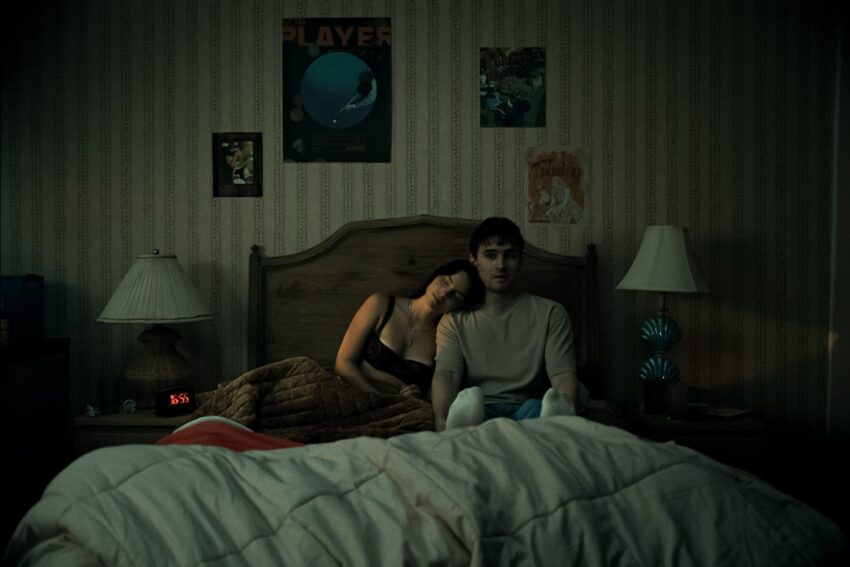
The most compelling criticisms of Obsession point to Barker’s insistence on centering Bear’s point of view as the film’s fatal flaw. A more daring, subversive filmmaker—or a more feminist one—would have focused on Nikki’s absolutely harrowing experience. And Barker does mean for the audience to sympathize with Bear, even as he is clearly “the real villain” of the piece. Some less compelling critiques have read this tension as a lack of moral clarity on Barker’s part. But I found this tension, as well as the strict adherence to Bear’s perspective, inherent to the aims of the project. It’s key to understanding Obsession as a new entry into the canon of what I like to call “yes all men, even you” fiction.
While I don’t believe all men are inherently evil, I do believe that men are socially and culturally primed to view women as objects. This conditioning leads them to accept and uphold gendered hierarchy through either the direct perpetuation of sexual violence or the tacit acceptance of it. Most women, through lived experience under the patriarchy, don’t need to be convinced of this fact. The majority of men, however, don’t consciously understand how this conditioning works.
So how do we go about opening men’s eyes to this state of things? The slogan “yes all men” emerged about a decade ago as a rejoinder to any protests that “not all men” are bad (unsafe, sexist, violent, rapists, etc.) when feminists make statements about the patriarchy. “Yes all men” serves as a reminder that every man is socialized to some degree to uphold the values of the patriarchy. For a man to contribute to the feminist project of dismantling it, he must accept this fact and actively check his implicit biases and privileges. Furthermore, he must check the biases and privileges of other men in his life in those “locker room” spaces where no women are around to observe. Talking about “good” and “bad” men misses the point. All men raised in a patriarchal society have a default setting, which is to protect the status quo from which they benefit; therefore, women have ample reason to decline to give unfamiliar men the benefit of the doubt.
The vast majority of feminist art, by definition, explicates and explores how it feels to live as a woman under the patriarchy. If art functions as an empathy machine, then, theoretically, men should be able to watch a feminist film and leave with a better understanding of this dynamic. For some men, it might work this way. But the rise of the manosphere has prompted many to wonder, “How do we get through to today’s shamelessly misogynistic young men?” These dudes are clearly not open to feminist art that gives women subjecthood.
There’s an assumed failure of empathy at play here. Listening to women isn’t an option. To reach this audience with a feminist message, one must Trojan Horse it into a story about a man. The man must be somewhat sympathetic, or else male viewers will immediately reject him as a “bad guy” who is “not like me.” As the story goes on, the depths of the protagonist’s depravity must be revealed incrementally so as to startle the viewer into recognizing that he, too, could potentially do what the protagonist does. Although the film as a whole doesn’t necessarily fit the definition, Bo Burnham’s not-so-nice nice guy character in Promising Young Woman is a prime example of what I’m talking about. (Both writer/director Emerald Fennell and Burnham himself even spoke about how they hoped the character would start discussion among men.)

This is “yes all men, even you” fiction. It’s a trick of perspective meant to send a shock of recognition through the male audience members, not the female ones. This particular mode of moralizing has yet to calcify into an established genre, and I think it’s why Obsession has sparked so much debate. It doesn’t quite feel like anything else we’ve gotten before, even as it smacks of conservatism. The message isn’t “mansophere coded,” but the way it’s delivered panders to men’s presumed inability to accept women’s subjectivity and personhood. And that’s as manosphere coded as it gets. It’s hard to call “yes all men, even you” fiction unreservedly feminist, as it functions by de-centering women. Yet its sole purpose is to scare men into realizing that they are the problem. “Yes all men, even you” fiction often feels fundamentally at odds with itself in this way.
Obsession pushes the man-coddling boundaries of “yes all men, even you” fiction, because Bear does some heinous shit throughout the course of the film. For one thing, it’s pretty much spelled out that every time Bear has sex with Wish Nikki, he’s raping Real Nikki. But Barker presents Bear as well-meaning (or, at the very least, convinced of his own good intentions) for the duration of the film. This choice doesn’t absolve Bear of his bad behavior, but it makes him a more relatable protagonist. By allowing Bear his delusions of victimhood, the film asks male viewers to confront their own.
While Obsession is perhaps the highest profile entry yet into the “yes all men, even you” canon, it’s not the gold standard. For my money, that distinction still belongs to The Witch Elm, Tana French’s 2018 mystery novel about an amnesiac man who becomes a suspect in an unsolved decades-old murder. I’ve read The Witch Elm three times, and every time I’m astounded by how deftly it weaves a tale of a completely average guy (white, heterosexual, natch) who can’t possibly stand not to be the center of a story. It’s a crime thriller told from an off-kilter, first-person perspective. Our narrator Toby Hennessey isn’t a detective, a criminal, or a victim of the relevant crime. He’s just a man, recovering from a traumatic head injury, caught up in the fray of a cold case investigation. I don’t want to spoil any of this novel’s many surprises and pleasures, but let’s just say that I’ve never read another book that excoriates a man for his privilege with such elegant stealth.
Judging from some of the responses to Obsession, “yes all men, even you” fiction may not be the way to enlighten the misogynists. If someone is determined to miss the point, they will miss it. But I remain fascinated with “yes all men, even you” fiction as a weird product of our masculinity-crisis obsessed times.